





In the engineering and design industry, software tools change—but the demand for practical CAD skills never goes away. Companies don’t just look at degrees anymore; they look at whether a candidate can work confidently on the software tools used in real projects.
Understanding which CAD software tools are widely used in the industry helps students and professionals make smarter learning decisions.

Why Knowing Industry-Standard Software Matters
Learning CAD software is not just about learning any tool—it’s about learning the right tools. Industry-standard software ensures:
Most organizations prefer engineers who are already familiar with the software they use daily.

Below are some of the most widely used CAD tools across engineering, construction, and design sectors.
AutoCAD remains one of the most commonly used CAD tools worldwide. It is extensively used for:
For many engineers, AutoCAD is the first professional CAD tool they learn.
Revit is a Building Information Modeling (BIM) software used in:
Revit is increasingly mandatory in infrastructure, real estate, and government projects where BIM compliance is required.
SolidWorks is widely used in mechanical and product design industries for:
It is especially popular in automotive, machinery, and industrial product sectors.
CATIA is known for its advanced capabilities and is commonly used in:
Companies working on large-scale and precision-driven projects rely heavily on CATIA.
Fusion 360 is gaining popularity due to its cloud-based workflow. It is used for:
Startups and design studios prefer Fusion 360 for its integrated approach.

Modern engineering workflows extend beyond basic modeling. Professionals also use CAD-related tools for:
Learning CAD today often includes exposure to these advanced applications.
Industry professionals rarely work on just one tool. A mechanical engineer may use:
Similarly, a civil or BIM professional may work with AutoCAD, Revit, and coordination tools together.
This is why multi-software exposure is becoming increasingly valuable.
The best software for you depends on:
Learning under proper guidance helps avoid wasting time on tools that don’t align with your career path.
CAD software tools are the backbone of modern engineering and design workflows. Professionals who understand industry-standard tools, workflows, and best practices stand out naturally in the job market.
Instead of learning software randomly, focus on structured, industry-oriented CAD training that prepares you for real-world expectations
Your email address will not be published. Required fields are marked *

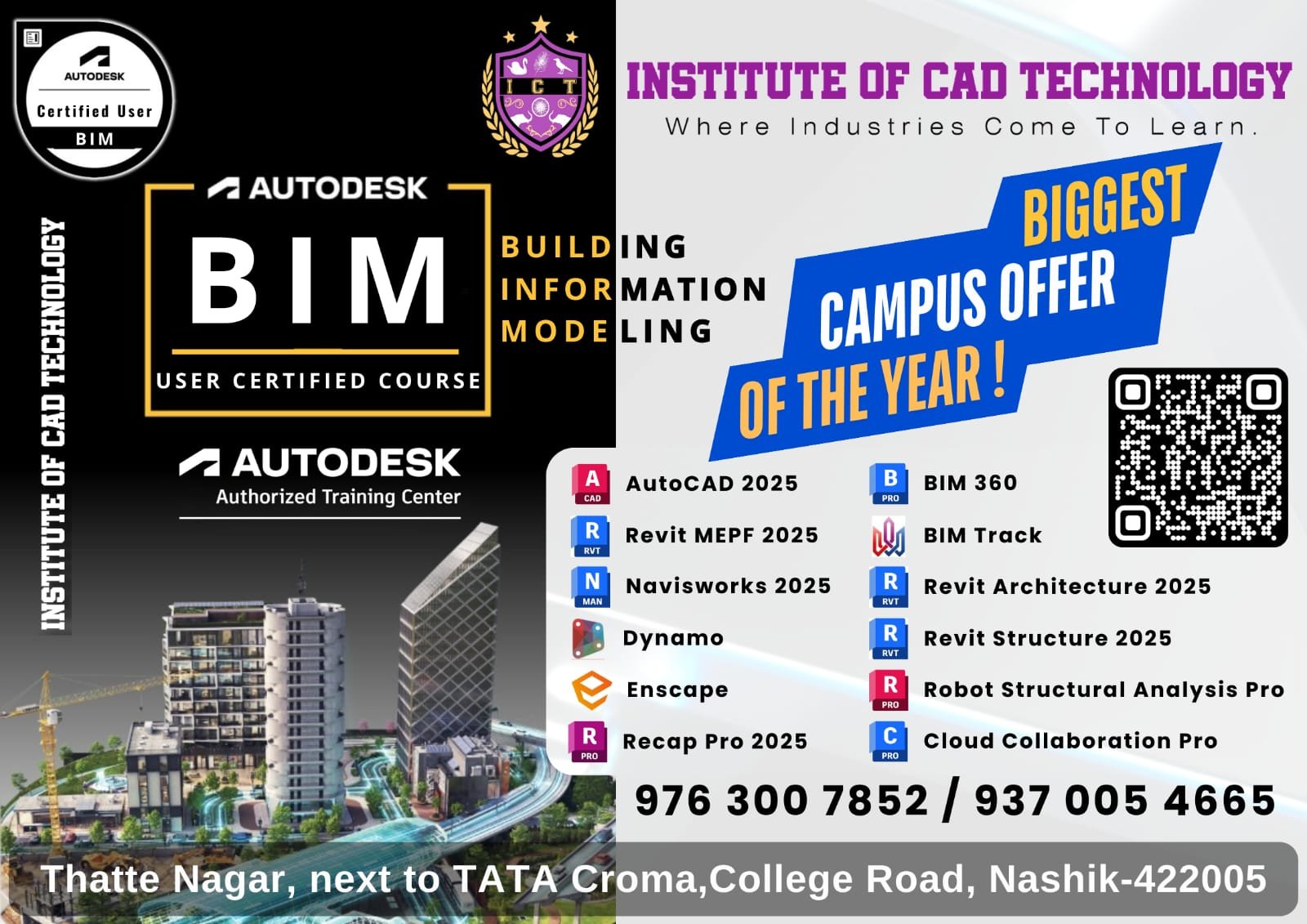
Biggest Campus Offer 2025 is here!
Get 100% assured Placement on the Autodesk Certified BIM Course
The INSTITUTE OF CAD TECHNOLOGY (ICT-NASHIK) is offering its most demanding Autodesk Certified BIM Job Course for Civil, Architecture & Structural Design candidates looking for a career in BIM
Limited Seats only!
New batch starts on 03-MAR-2025 Onwards!
Enroll Now!!!
Contact for more information
91758 33301 / 97630 07852